
An India-to-Sharjah transfer almost never arrives with a tidy handover date. The Mumbai or Hyderabad flat empties out weeks before the Sharjah villa or apartment is ready, and everything from the dining table to the children's study desks suddenly needs somewhere safe to sit while the paperwork catches up. Families who have done this move once usually say the same thing afterward: the hard part was never the flight, it was the gap in between.

Doorstep pickup and insured storage are built for exactly this kind of in-between period.
- A Sharjah relocation rarely lines up neatly with an India move-out date, so a storage bridge is usually needed on the UAE side.
- Not everything should travel at once — some items can wait in Sharjah storage until the new home is confirmed.
- Barcoded inventory matters more on a cross-border move, where you cannot just "pop back" to check a box.
- Office relocations follow the same gap problem when a company opens or expands a Sharjah branch.
- Visa processing, tenancy contracts and school terms are the three dates that usually decide your storage timeline.
Why Transfers to Sharjah Create an Awkward Storage Gap
A posting to Sharjah usually comes with a start date for work and a much vaguer date for housing. Visa stamping, a security deposit, and a tenancy contract that has to be signed before you can even view furniture placement all take time that the employer's relocation timeline rarely accounts for. Meanwhile, the India side of the move is already in motion — the old flat has a notice period, and movers are booked around that, not around when the Sharjah lease starts. The result is a window, often two to six weeks, where belongings exist but a home does not yet.
This is the exact problem that doorstep pickup and storage is meant to solve. Instead of trying to force two timelines to match, you let storage absorb the mismatch: pickup happens on the India side (or on arrival in Sharjah, depending on how you ship), and items sit safely until the new address is ready for them.
What to Send First, What Can Wait in Storage
Most families over-plan the shipment and under-plan the gap. A simpler way to think about it is to split belongings into three buckets.
| Category | Examples | What usually works best |
|---|---|---|
| Needed immediately | Documents, work laptop, a week of clothes | Carry with you, never store |
| Needed once settled | Kitchen items, bedroom furniture, clothing | Store short-term, scheduled for return |
| Needed eventually | Seasonal items, books, décor, spare furniture | Store long-term, retrieve on request |
Splitting things this way means you are not paying to keep everything accessible, and you are not stuck waiting on a single shipment before the new place feels livable.
How Doorstep Pickup Works Once You Land
For families bringing belongings into Sharjah directly, the process is the same regardless of where the move originates: items are collected from your current address, each box and piece of furniture is barcoded and logged against an inventory, and the lot is held in a secure warehouse until you call for it. Partial retrievals are common — you might ask for the bedroom set when the lease starts but leave the rest in storage until the kids' room is painted.
Documents, Insurance and Why Barcoded Inventory Matters More Abroad
On a local move, a misplaced box is an inconvenience — you can drive back and check. On a cross-border relocation, it is a much bigger problem, because you are often not in a position to go looking. This is why insured storage with a barcode system attached to every item is worth paying attention to specifically for this kind of move: it means you can verify from your phone that the sofa, the saree boxes, or the kids' toys are logged and accounted for, without needing to be physically present.
Office Relocations: When a Company Opens a Sharjah Branch
The same gap shows up for businesses. An Indian company setting up a Sharjah office often signs the lease before the fit-out is finished, or ends up waiting on a trade licence before furniture can even move in. Desks, filing cabinets and IT equipment can be picked up, barcoded and held the same way household items are, so the opening date for the office does not get pushed back just because the space was not technically ready for furniture yet.
Timing Your Move: Visa, Tenancy and School Term Dates
If you are planning a transfer, work backward from three dates rather than one: when your visa and Emirates ID processing is expected to complete, when the tenancy contract actually starts, and when the school term the kids need to join begins. Storage is most useful as the buffer between these three, rather than something you arrange at the last minute once the India side has already emptied out.
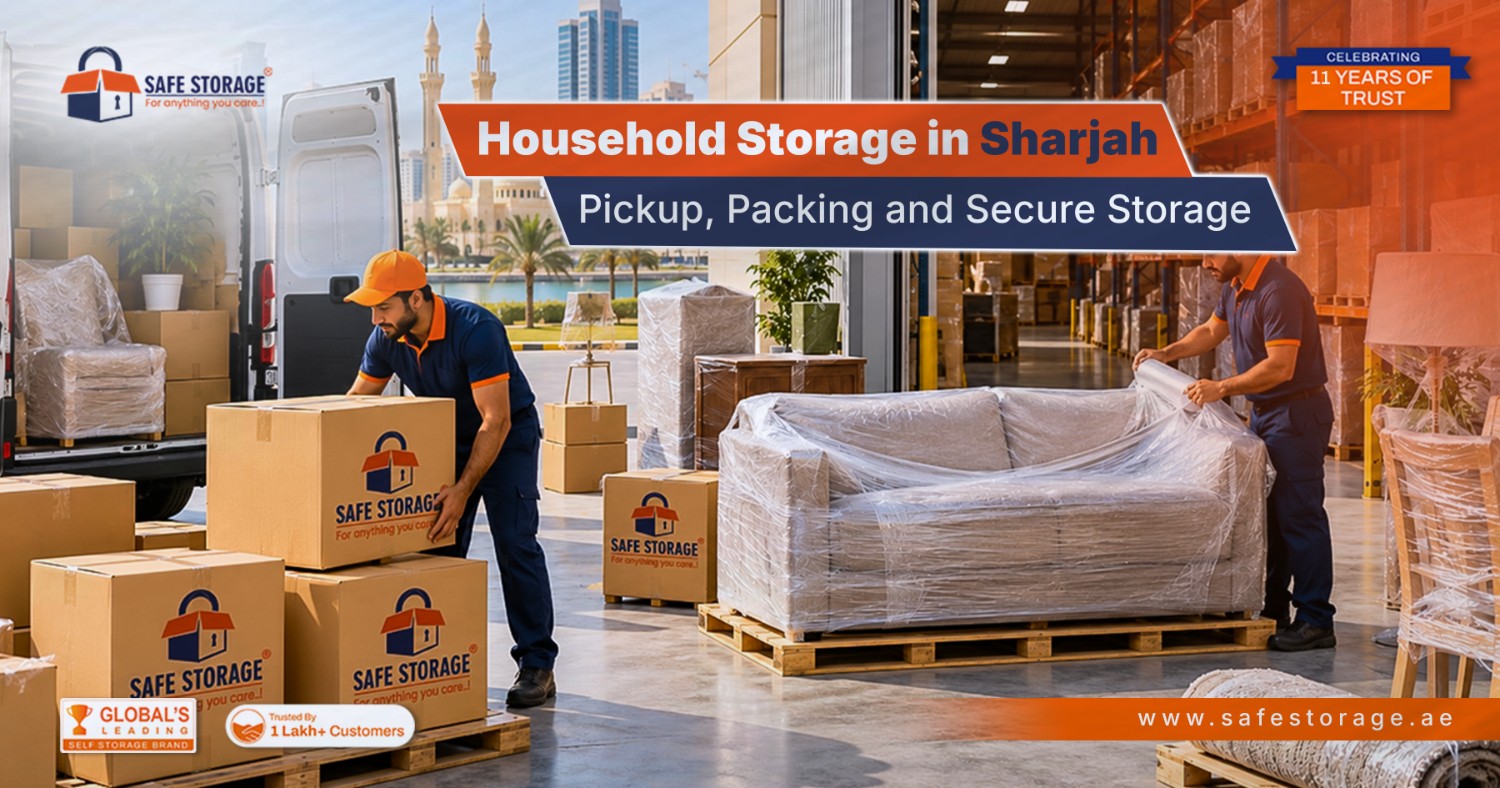
Household storage in Sharjah, built around pickup, packing and secure holding.
Do I need to be in Sharjah for pickup to be arranged?
No. Pickup and storage can be scheduled and tracked remotely, which is useful when one spouse travels ahead to start the job while the rest of the move is still being organised.
Can I store only part of my shipment and keep the rest with me?
Yes. Splitting belongings into what you need immediately and what can wait is the normal approach for a transfer, and retrieval can be scheduled for whenever the new home is ready.
Is office furniture handled differently from household items?
Not really. Desks, filing cabinets and IT equipment are picked up, barcoded and logged the same way, which matters for businesses opening a Sharjah branch on a timeline that does not match the fit-out schedule.
How do I know my items are safe while I'm still settling in?
Each item is logged against a barcoded inventory at pickup and covered by insurance while in storage, so you can check what is held and where, without needing to visit the warehouse in person.
If an India-to-Sharjah transfer is on your calendar, it is worth looking at how SafeStorage handles the pickup-to-storage gap before the move-out date arrives, rather than scrambling to arrange it once the old flat is already empty.

No comments:
Post a Comment