Monday, 12 October 2026

Lucknow Households: Six Life Events That Decide Your Storage Term

Most Lucknow families don't decide between short-term and long-term storage by thinking about duration at all — they decide based on whatever life event is forcing the question. A wedding in the family, a parent's transfer, a renovation that's dragging on, a child moving out: each of these points to a different storage term, and most households never stop to notice the pattern.

Need Storage in Lucknow? Get a Quick Quote Today

The life event behind your storage need usually tells you the right term before you even compare prices.

Key takeaways
  • The life event driving your storage need almost always signals short-term or long-term before anything else does.
  • Festivals, renovations, and short trips point to short-term; transfers and downsizing point to long-term.
  • Storage in Lucknow starts at Rs 99 a month with zero deposit and zero lock-in, so you're not penalised for guessing wrong.
  • The one-month minimum period means even a short-term decision never traps you.
  • Doorstep pickup means the storage decision doesn't require a free weekend to execute.

Event 1: Renovation

A kitchen or bathroom renovation in Lucknow usually runs a few weeks to a couple of months. Furniture, appliances, and anything that can't sit under dust and debris needs to move out temporarily — this is a textbook short-term case, and it rarely justifies anything beyond that.

Event 2: A wedding or festival in the house

Before a big family event, rooms get cleared to make space for guests, and after it, there's usually a pile of gifts, extra furniture, or decor that needs somewhere to go while the house gets back to normal. This is short-term almost every time — weeks, not months.

Event 3: A transfer out of Lucknow

A posting to another city or abroad changes the equation entirely. Some belongings travel, some get sold, and what's left — property papers, furniture you're not ready to part with, family items — often needs to sit safely for a year or more. That's long-term by nature, not by accident.

Event 4: Downsizing after kids move out

  • A smaller flat makes sense once the house empties out, but years of accumulated furniture and belongings don't just disappear.
  • Most families aren't ready to sell or discard everything immediately — long-term storage bridges that gap without forcing a rushed decision.
  • This is one of the clearest long-term cases we see, and one families often delay until the move is already underway.

Event 5: A short stay elsewhere — hostel, a relative's place, a temporary posting

If the plan is to come back to Lucknow within a few months, short-term storage avoids paying ongoing rent or asking relatives to hold onto furniture they didn't ask for.

Life eventTypical term
Home renovationShort-term
Wedding or festival at homeShort-term
Transfer out of LucknowLong-term
Downsizing after kids move outLong-term
Short stay at a hostel or relative's placeShort-term
Affordable Long-Term Storage Options In Coimbatore – SafeStorage 2026 Guide

The same decision logic that works for one city's households works for Lucknow's too.

Tip: If your life event could plausibly stretch longer than planned — a renovation that's already been delayed once, for instance — start short-term anyway. With no lock-in, extending costs you nothing extra, while overcommitting to long-term upfront does.

Event 6: Moving in with family temporarily

Whether it's staying with in-laws for a while or bunking in with siblings during a transition, most of your own household's belongings won't fit into someone else's home. This usually sits in the middle — treat it as short-term first, and extend if the transition runs longer than expected.

What if our life event doesn't clearly match any of these?

Start short-term. The one-month minimum and no-lock-in structure mean there's no cost to starting cautiously and extending if needed.

Do we need to pack everything ourselves before storage?

Pickup happens from your door, so you're not required to transport anything to a facility yourself.

How much does storage in Lucknow actually cost?

Plans start from Rs 99 a month, with no deposit required and no lock-in period.

Who do we call to get started?

080888 48484 for a free quote — they'll help match the term to your specific situation.

A quick way to check yourself before you decide

  • Write down the actual event causing the storage need, in one sentence — not "we need space," but "we're renovating the kitchen" or "my father's getting transferred to Kanpur."
  • Ask whether that event has a natural end date you can point to on a calendar. A renovation does. A downsizing move usually doesn't.
  • If you can name the end date, lean short-term. If you can't, don't force a short-term plan just because it feels less committal — it usually means more renewals and more hassle later.
  • Talk to whoever else is involved in the decision before booking — a parent, a spouse, a sibling — since the "temporary" plan one person has in mind is often different from what everyone else is assuming.

None of these six events are rare. Most Lucknow households will run into at least two or three of them over a decade, and the families who plan the storage term around the actual event — rather than guessing at a duration — tend to spend less and move boxes around less often.

Whatever life event is behind your storage need right now, the full comparison is at safestorage.in's Lucknow storage guide — read it before you commit to either term.


Saturday, 10 October 2026

5 Red Flags to Avoid When Choosing a Storage Company

We get a lot of calls from people who tried a storage company once, had a bad experience, and almost gave up on the idea entirely. Nine times out of ten, the problem wasn't storage itself — it was a provider who skipped the basics. Here are the warning signs worth watching for before you sign anything.

Storage Companies: How To Pick The Right Storage Partner In 2026 For Your Household, Personal and Business Needs

A bad storage experience usually traces back to one of a handful of avoidable red flags.

Key takeaways
  • No inventory list or itemised record is the single biggest red flag in storage.
  • Vague pricing that changes after pickup is a sign to walk away.
  • A facility that won't describe its pest control or security setup is hiding something.
  • Slow or unclear retrieval policies turn "safe storage" into a headache when you actually need something back.
  • A legitimate provider will have a defined minimum period and clear terms upfront.

Red Flag 1: No Item-Level Inventory

If a provider simply counts boxes instead of logging what's inside them, you have no real way to confirm anything later — whether it's all there, whether something was damaged, or which box actually holds what you need. A proper storage company barcodes or itemises your belongings before they ever leave your home, so you have a record independent of memory or guesswork.

Red Flag 2: Pricing That Isn't Clear Upfront

Storage pricing should be simple to understand before you commit, not something that gets "adjusted" once your items are already in their warehouse. A transparent provider tells you the monthly rate and minimum period clearly — for context, plans can start from as little as Rs 99 per month with a minimum period of 1 month, which gives you a sense of what a fair, upfront structure looks like. If a company is vague about cost until after pickup, that's leverage against you, not in your favour.

Red Flag 3: No Real Answer on Pest Control or Security

Ask directly how a facility handles pest control, fire safety and access security. A company with nothing to hide will answer specifically — fumigation schedules, CCTV coverage, guarded access. Vague reassurance ("don't worry, it's all safe") without specifics is usually a sign the facility hasn't actually invested in these basics.

Red flagWhy it mattersWhat to ask instead
No itemised inventoryNo proof of what's stored or its condition"Is every box individually logged?"
Unclear pricingCosts can change after your items are already there"What's the monthly rate and minimum period?"
Vague on security/pest controlBelongings may be exposed to damage or theft"Can you describe your pest control and access security?"
Slow retrieval processDefeats the purpose of flexible storage"How soon can I get an item back once I request it?"
How to Pick the Right Storage Unit for Your Needs

Asking the right questions upfront avoids most of the common storage headaches.

Red Flag 4: Retrieval That Takes Too Long or Costs Extra Surprises

Storage should give you flexibility, not lock your belongings away until it's inconvenient to get them back. If a provider is unclear about how retrieval works, or charges fees that weren't mentioned upfront, that's a sign the convenience you're paying for doesn't actually exist. A reliable company will tell you clearly, before you sign up, how requesting an item back actually works.

Red Flag 5: No Clear Contact or Support Line

If you can't easily reach someone to ask a question before you've even committed, that's a preview of what support will look like once your belongings are already stored. A company worth using makes itself reachable — for reference, our own team can be reached directly at 080888 48484 for exactly these kinds of questions before you decide.

Tip: Before booking, ask for the inventory process, pricing, and retrieval policy in writing. A provider that's comfortable putting this in writing is almost always the safer choice.

What a Trustworthy Storage Partner Actually Looks Like

Strip away the marketing language and a good storage company comes down to a few unglamorous things: they log what you give them, they're upfront about cost and minimum period, they can describe their security and pest control specifically, and they make retrieval straightforward. None of this is complicated, which is exactly why it's worth checking before you commit rather than discovering the gaps after your belongings are already sitting in someone else's warehouse.

Is it normal for storage pricing to change after pickup?

No — a transparent provider confirms pricing and the minimum period before pickup, not after your items are already in storage.

How can I verify a storage company's security claims?

Ask specific questions about CCTV, access control and pest management rather than accepting general reassurance, and expect specific answers in return.

What should a fair minimum storage period look like?

A clearly stated minimum period, such as one month, with no hidden extension clauses, is a reasonable standard to expect from any provider.

Should I be able to retrieve just one box, not the whole shipment?

Yes — with proper item-level inventory, you should be able to request specific items back without needing to collect everything at once.

Before you commit to any storage company, run through these red flags first. If a provider like SafeStorage answers every one of these questions clearly and upfront, you're in much safer hands than you would be otherwise.

Thursday, 8 October 2026

What Every Indian Family Relocating to JLT Should Pack Last

If you're an Indian family packing up a flat to move into a tower in Jumeirah Lakes Towers, you've probably discovered that "international relocation" checklists online are written for people who fly with two suitcases, not for households with a decade of furniture, kitchen gear and a child's school project trophies. The truth is messier: most of what you own either travels with you, gets sold off in a rush, or sits in a relative's spare room back home collecting guilt. There's a fourth option that Dubai-bound families in Bangalore, Mumbai and Delhi are using more often — storing the in-between stuff properly, on both ends of the move.

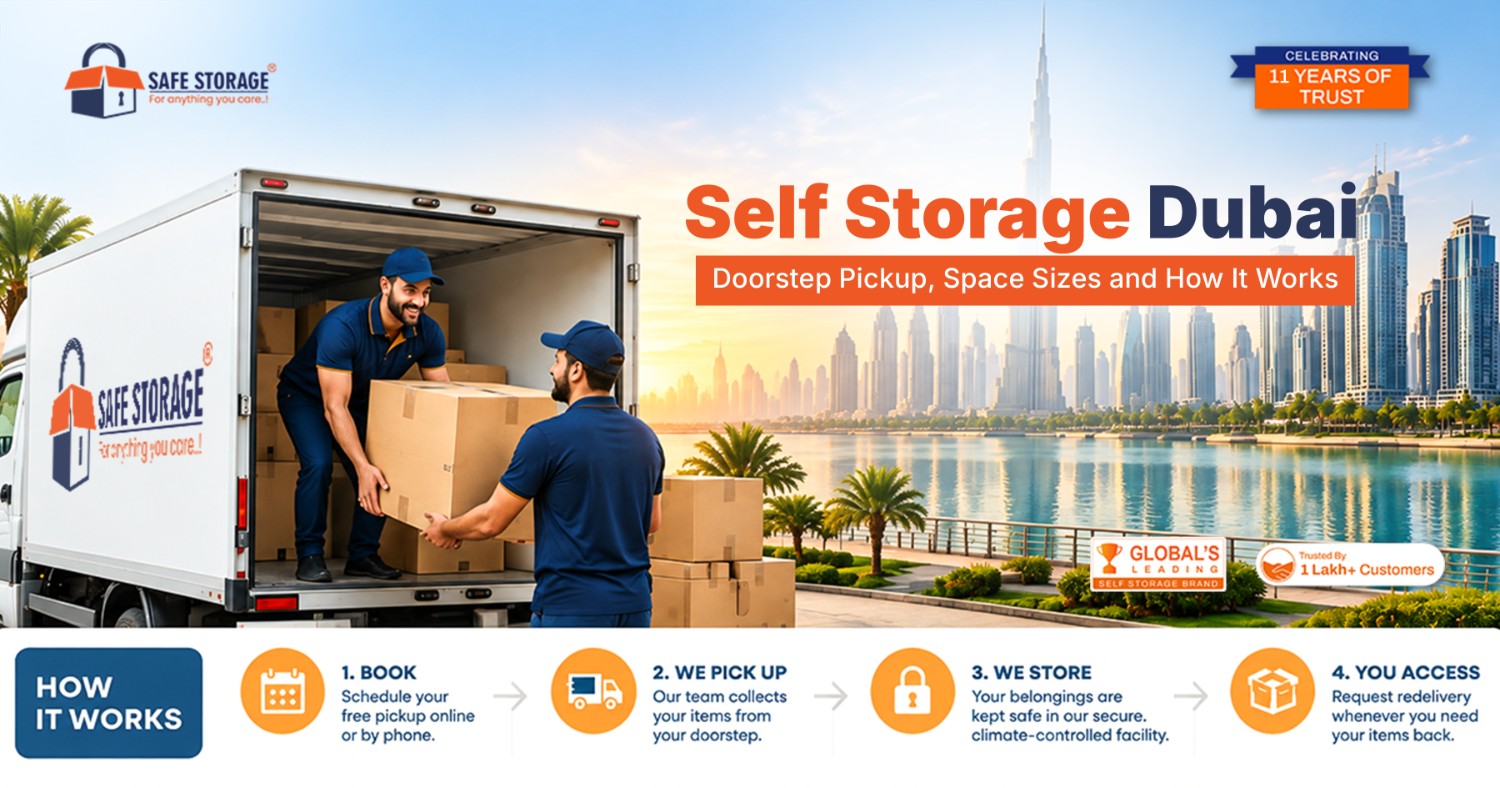
Self Storage Dubai: Doorstep Pickup, Space Sizes and How It Works

Doorstep pickup means your JLT move doesn't start with a van search.

Key takeaways
  • A JLT relocation usually happens in two stages — downsizing in India, then settling into a smaller Dubai footprint — and each stage needs its own storage decision.
  • Doorstep pickup matters more for an international move, since you won't have a car or a free weekend to shuttle boxes once you land.
  • Barcoded inventory lets you track what's stored back in India from your phone in Dubai, which matters when a move spans two countries.
  • JLT apartments are mostly compact 1- and 2-bedroom layouts, so plan for less built-in storage than you had at home.
  • Insurance on stored goods matters more, not less, once your furniture is sitting in a different country than you are.

Why a JLT Move Isn't Just a Bigger Version of an Indian House Shift

Moving between Indian cities, you can always rent a slightly bigger truck or make a second trip. Moving to JLT removes that flexibility. Shipping is expensive, apartment towers have strict moving-hour windows and loading-dock rules, and most new arrivals are renting furnished or semi-furnished units that simply don't need the dining table and wardrobe set that filled an Indian flat. The honest first step isn't packing — it's deciding what actually needs to leave India at all.

  • Documents, heirlooms and anything irreplaceable usually stay with family or in dedicated storage, not in shipping crates.
  • Furniture bought for an Indian-sized bedroom rarely fits a JLT studio or one-bedroom layout.
  • Seasonal or occasional-use items (festival décor, winter clothes if you're coming from North India) are easy to defer rather than ship immediately.

The Two-Sided Storage Problem Nobody Mentions

Families moving to JLT often store twice: once in India, holding back what they're not shipping yet, and once in Dubai, for the first few weeks or months before they know their new apartment's layout well enough to buy furniture that fits. Trying to solve this with a single shipment and no storage buffer is how people end up with a sofa wedged in a hallway or boxes stacked against a Dubai balcony door.

StageWhat usually gets storedWhere it makes sense
Before the India exitFurniture, documents, items for a future returnStorage in your home city
First weeks in JLTExcess boxes, off-season items, duplicate kitchenwareShort-term Dubai storage near your tower
Once settledAnything still unused after a few monthsLong-term storage or donate/sell
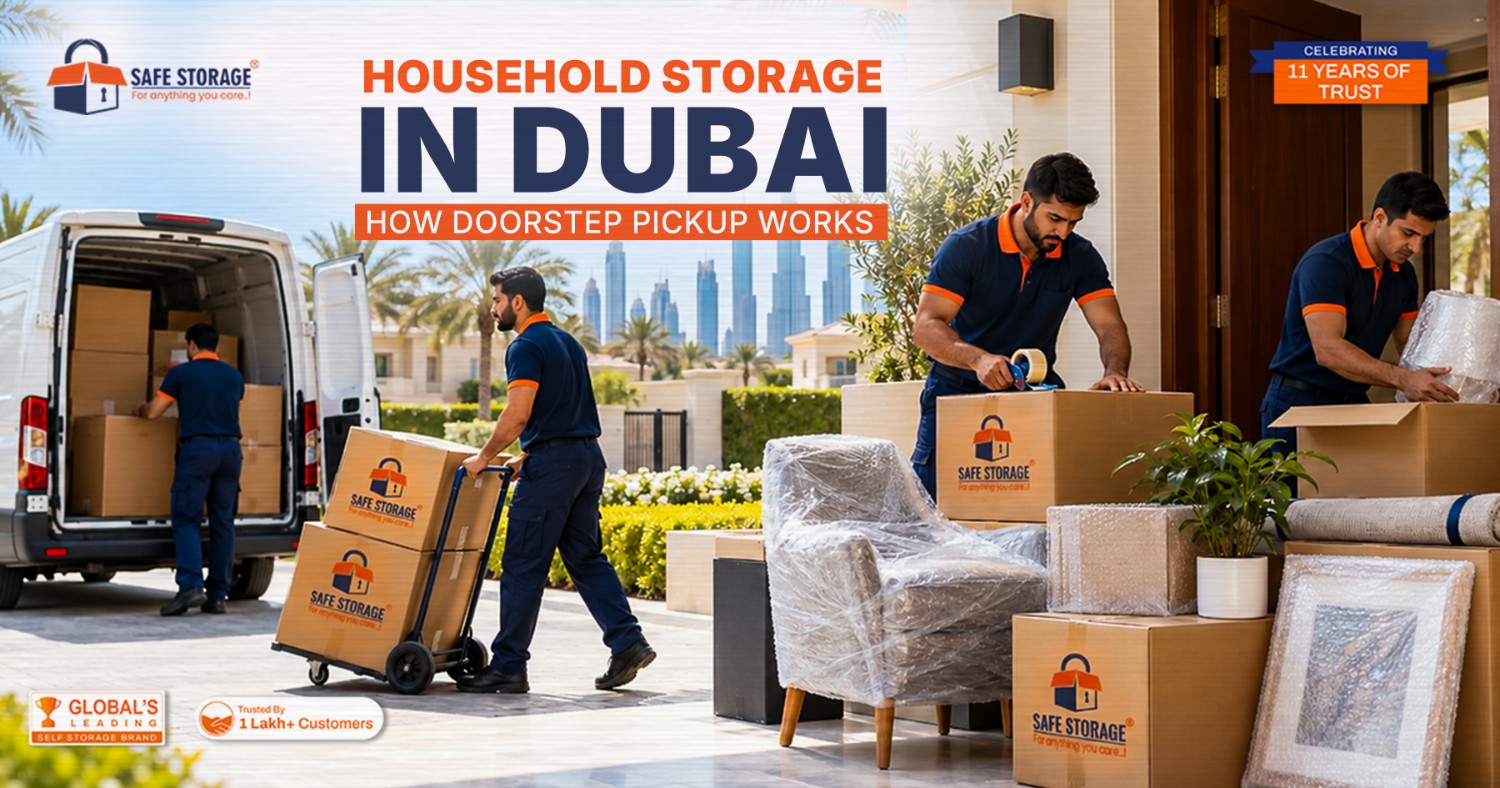
Household Storage in Dubai: How Doorstep Pickup Works

A barcoded box is easier to track across two countries than a mental list.

What to Look for in JLT Storage Before You Even Land

If you're arranging this remotely from India, you want a provider that doesn't require you to show up in person to start or manage a plan. Three things matter most for a family arriving from abroad: pickup that comes to the apartment instead of requiring a facility visit, a way to see and search your inventory online, and clear insurance terms, since replacing furniture from India isn't realistic if something goes wrong in storage.

  • Doorstep pickup — useful when you've just landed and don't yet have a car or know the city.
  • Itemised, searchable inventory — so you can request back a specific box, not the whole lot, as your apartment gets organised.
  • Partial retrieval — pull out winter clothes or kitchen items as you need them, instead of all-or-nothing storage.
Tip: Before your shipment leaves India, photograph and list every box's contents in a shared note. It makes matching boxes to your Dubai storage inventory far faster once everything arrives.

Settling Into JLT Without the Clutter Catching Up

Once you're in the apartment, the instinct is to unpack everything at once. For a JLT move, it's usually smarter to unpack only what the layout can actually hold, and keep the rest in storage nearby until you've lived in the space long enough to know what you're missing versus what you brought out of habit. That's especially true for families who shipped furniture sized for a bigger Indian home.

Do I need to store things in both India and Dubai, or just one?

Most families end up doing both for the first few months — holding items back in India they're not ready to part with, and storing the overflow in Dubai until their new apartment is fully set up.

What shouldn't go into long-term storage in Dubai?

Anything perishable, documents you need for visa or tenancy processes, and daily essentials — keep those with you, not in storage, during the transition period.

How soon after arriving in JLT can I arrange storage?

You can typically book doorstep pickup as soon as you have an address, even before you've finished unpacking your first shipment.

Is storage only useful during the move itself?

No — many families keep a small storage plan running for months, especially for seasonal items or furniture they're deciding whether to keep.

If your move to JLT is still in the planning stage, it's worth reading through what doorstep storage in JLT actually involves before you finalise your shipping plan — it may change how much you decide to bring in the first place.

Monday, 5 October 2026

Setting Up in Sharjah? What Indian Business Owners Forget to Plan For

More Indian companies are opening a Sharjah office every quarter than most owners realise, chasing the UAE's tax position and its doorway into the Gulf. The part nobody plans for is the gap between "we signed the lease" and "we have a working office," and in that gap sits every desk, carton of files and unopened server box with nowhere to go. If your business is eyeing a Sharjah move, here is the storage piece of that plan.

Household Storage in Dubai: How Doorstep Pickup Works

Doorstep pickup is the same model whether the goods are moving into a Sharjah office or an Indian flat.

Key takeaways
  • Sharjah business storage runs on doorstep pickup, so an Indian firm's Sharjah team never has to find or drive to a warehouse.
  • Every box and item gets a barcoded inventory, which matters when the person checking the list is sitting in Mumbai, not Sharjah.
  • The same pickup-catalogue-retrieve model is used for offices, shops and warehouses, so it scales as the branch grows.
  • Flexible plans mean a new branch can store furniture and stock without signing a long-term warehouse lease on day one.
  • Items are insured while stored, which is one less thing for a head office managing risk from a distance to worry about.

Why This Comes Up for Indian Businesses Specifically

An Indian company setting up in Sharjah usually inherits a strange problem: too much stuff, too early. Office furniture arrives before the fit-out is finished. Stock lands before the shop shelving is up. Paperwork and compliance files pile up because nobody budgeted office storage into the first year. Back home, the instinct is to rent a bit of extra warehouse space and sort it later. In Sharjah, that "bit of extra space" is a commercial lease most new branches don't need yet. Doorstep pickup storage solves the same problem without the lease.

How Doorstep Pickup Actually Works

The process is built for people who are already stretched thin running a new branch:

  • SafeStorage collects the furniture, stock, documents or equipment directly from the Sharjah premises.
  • Packing materials are used for anything fragile or awkward shaped before it's moved.
  • Every box and item is barcoded and logged, so there is a digital inventory rather than a mental one.
  • Goods are held at a guarded facility until the branch calls for them back, in part or in full.

Nobody on the ground has to drive a van to a storage yard, queue to drop boxes, or try to remember what went into which crate six months later.

What Usually Ends Up in Storage During a Sharjah Setup

Branch SituationWhat Typically Goes Into Storage
New office being fitted outDesks, chairs, cabins ordered early
Shop or showroom openingStock and shelving before the unit is ready
Head-office archivingCompliance files and records from the Indian parent
Warehouse or logistics branchEquipment and pallets ahead of a lease start date
Self Storage Dubai: Doorstep Pickup, Space Sizes and How It Works

Space is scaled to what a branch actually has, not a fixed warehouse unit.

Managing It From India While the Branch Runs Locally

The real advantage for an Indian head office is the barcoded inventory. A finance manager in India can ask what's in storage and get a specific answer, rather than a phone call to someone walking around a yard in Sharjah. When the branch needs one box of signed contracts back, that's a retrieval request against a known item, not a search.

Where This Fits Against Renting Extra Space

Commercial space in Sharjah is signed in multi-year terms more often than not. A branch that's six months old and still finding its footing rarely knows yet how much permanent space it needs. Storing the overflow and bringing it back as the office fills out avoids locking into a unit sized for a guess.

Tip: Before your Sharjah branch takes delivery of furniture or stock, arrange storage pickup first. It's far easier to move items from storage into a finished office than to store them around desks that are already in use.

Can storage be arranged before our Sharjah office lease even starts?

Yes. Pickup can be scheduled for whichever premises goods are currently sitting at, including a temporary address, ahead of the office being ready.

Does the inventory list distinguish between individual boxes?

Each box and item is barcoded separately, so a single carton of files can be identified and retrieved without pulling out everything else.

Is this only for offices, or does it work for retail stock too?

It covers offices, shops and warehouses alike — the same pickup and barcoding process applies whether it's desks, shelving stock, or equipment.

What happens to stored items if we need them back on short notice?

A retrieval request is placed against the barcoded inventory, and the specific items are brought back rather than the whole consignment.

If your company is in the middle of a Sharjah setup and the furniture, stock or files have nowhere to sit, this breakdown from SafeStorage walks through exactly how the pickup and inventory process works for a new branch.

Friday, 2 October 2026

Running a Business Across India and the UAE? Here's the Storage Gap

More Indian entrepreneurs than ever are running a business that straddles two cities — a team in Bangalore or Mumbai, and a second office taking shape in Dubai or Abu Dhabi. The part nobody warns you about is how quickly the UAE side accumulates physical stuff: sample units, trade licence paperwork, a growing stack of boxes nobody has time to sort through.

Need Storage Space for Rent in Dubai Marina? Secure Storage Guide

A UAE office often fills up faster than founders expect, especially in the first year.

Key takeaways
  • Running a business across India and the UAE means physical assets pile up on the side you visit less often.
  • A guarded, inventoried storage space solves this better than an oversized office lease taken "just in case."
  • Barcoded tracking lets a remote founder know exactly what's held without flying over to check.
  • Teams should separate working stock from paperwork and equipment that's simply waiting to be needed again.
  • Doorstep pickup matters most when the founder isn't in the country to manage it personally.

The Two-City Business Problem

When an Indian business owner opens a UAE branch, the instinct is often to rent office space sized for where the team will be in two years, not where it is today. That extra space ends up as an informal storeroom — stock in one corner, old furniture in another, a filing cabinet nobody has opened in months. It works until the lease renewal forces a decision, or until an employee can't find something important during an audit.

A better approach: keep the office sized for the working team, and move anything that isn't used weekly into a dedicated storage plan that the team can request from when needed.

What Dual-Country Founders Typically Need to Store

  • Trade licence documents, contracts and tax records specific to the UAE entity
  • Product samples and trial inventory before a formal distribution deal is signed
  • Furniture and equipment left over from a smaller first office
  • Marketing material used only at specific events or seasons

Comparing the Usual Options

Option Trade-off
Oversized office leaseCostly for space that sits mostly unused
Informal storage at a staff member's homeNo accountability, hard to track as the team grows
Shipping items back to IndiaExpensive and slow for items that will be needed again in the UAE
Dedicated inventoried storageScales with the team, retrievable item by item
Secure Storage Services in Business Bay for Offices and Startups

Startups in particular benefit from storage that scales rather than a fixed unit size.

Managing It From the India Side

Founders who still spend most of their time in India need visibility without needing to be physically present. A barcoded inventory system matters here specifically because it lets the founder or an India-based finance team confirm what's held and request documents back without anyone needing to fly over to check a cupboard.

This also solves a quieter problem: accountability when the UAE team changes. Staff on the ground come and go, and informal arrangements — a spare room at someone's apartment, a shelf in a shared warehouse a vendor offered for free — tend to fall apart exactly when a founder needs something urgently. A documented inventory outlives any single employee's tenure, which matters more than it sounds once a company has been operating in the UAE for a couple of years.

When This Becomes Urgent Rather Than Optional

Three moments tend to force the issue. The first is a lease renewal, when the cost of the extra "storage" space the office has informally become suddenly shows up as a line item worth questioning. The second is an audit or investor due diligence process, when someone outside the company asks where specific documents physically are. The third is simply running out of floor space before anyone planned for it. Businesses that set up proper storage before any of these moments arrive tend to handle them with far less scrambling than those that wait.

A Simple Framework Before You Sign a Bigger Lease

  1. List everything currently sitting unused in the UAE office
  2. Separate it into documents, stock and equipment
  3. Decide what genuinely needs daily access versus occasional retrieval
  4. Move the rest into storage before renewing or upsizing the office lease
Tip: Review what's in storage every few months rather than letting it sit indefinitely — a growing team's needs change faster than a founder managing things remotely might expect.

Is it common for Indian founders to run a UAE branch without relocating full-time?

Yes, this is increasingly common, particularly for founders who split time between the two countries during the early growth phase.

Can storage be arranged without the founder being physically in the UAE?

Generally yes — a local team member or office manager can coordinate pickup, while the founder retains visibility through the inventory system.

What should be stored separately from general office items?

Trade licence documents, contracts and anything with a compliance or audit requirement should be tracked with more detail than general furniture or equipment.

Does this apply only to startups, or also to established businesses?

Both — established businesses opening a UAE branch face the exact same overflow problem as startups, just often at a larger scale.

Founders weighing up office space versus a proper storage plan for their UAE operations can see what's actually included at SafeStorage before committing to a bigger lease than the team currently needs.

Wednesday, 30 September 2026

Moving to Dubai? Don't Let Your Old Paperwork Move With You

If you're an Indian family packing up for Dubai, or a founder opening a second office there, the boxes are rarely the hard part. It's the paperwork — contracts, HR files, old certificates, the folder nobody labelled — that ends up shoved into a suitcase or, worse, left behind with a relative "just in case." There's a calmer way to handle it on both ends of the move.

Secure Household Storage in Dubai – Doorstep Moving and Pickup Available

Doorstep pickup makes cross-border moves easier to manage, whether it's a full household or a few boxes of files.

Key takeaways
  • Relocation paperwork (tenancy, HR, education certificates) is the easiest category to lose track of during an India-to-Dubai move.
  • Guarded, barcoded storage in Dubai means a single box can be retrieved on request instead of digging through a stack.
  • Businesses expanding into the UAE often need to archive HR and finance records they're legally required to keep but don't need on-site.
  • Climate-aware storage matters for paper records in the Gulf, where heat and humidity are harder on documents than in most Indian cities.
  • Doorstep pickup removes the need to carry boxes yourself during an already stressful relocation.

Why Relocation Paperwork Piles Up So Fast

Moving between countries multiplies the amount of paper you're suddenly responsible for. You're not just packing a household — you're carrying tenancy agreements from your old flat, school and university certificates, medical records, old employment letters, and whatever your new UAE employer or landlord asks for next. Add a small business into the mix, with HR files and vendor contracts that still need to exist somewhere, and "I'll deal with it later" stops being a plan.

What Indian Families Moving to Dubai Usually Need to Store

Most households we talk to fall into a few predictable groups:

  • Families who've sold or rented out their India property and are holding onto ownership papers, agreements and old utility records
  • Professionals relocating for work who still have Indian bank statements, tax records and certificates they're required to retain
  • Parents storing children's school records and medical files during the transition between systems
  • NRIs who keep a foothold in both countries and don't want documents scattered across two homes

None of these need to travel in a carry-on bag, and none of them belong in a drawer that gets forgotten.

Businesses Expanding to Dubai: Contracts and HR Files

Companies opening a UAE branch face a similar problem at a larger scale. HR files, signed contracts, finance archives and old invoices often have to be retained for a set number of years, but they don't need to sit in a Dubai office taking up desk space or a filing cabinet nobody trusts. A guarded storage facility with barcoded tracking means the finance team can request one specific folder back without anyone rifling through five years of paperwork to find it.

How Barcoded Tracking Actually Helps When You're Two Countries Away

The detail that matters most for anyone managing a move remotely is traceability. Every box collected is barcoded and logged against the account, with an inventory list shared back before it's out of sight. That means a parent in Bangalore who's just shipped their son's paperwork to Dubai can confirm exactly what's in storage, and request a specific box back, without a phone call chain to figure out where anything is.

Situation What usually gets stored
Family relocating permanentlyProperty papers, old certificates, tenancy records
Professional on a work moveBank and tax records, employment letters
Business opening a Dubai officeHR files, signed contracts, finance archives
NRI household with a foot in both countriesMixed personal and property documentation
Secure Self Storage in Dubai Silicon Oasis: Your Complete 2026 Guide

A guarded facility built for exactly this kind of long-term document storage.

Tip: Before you pack a single box for the move, separate "documents I need in the first month in Dubai" from "documents I just need to keep." Only the first group should travel with you — the rest can go straight into guarded storage.

Frequently Asked Questions

Can documents be stored securely in Dubai's climate?

Yes — a guarded, climate-aware facility is built specifically to handle paper records in conditions where heat and humidity would otherwise damage them over time.

Do I need to sort everything before it's collected?

No. You can drop off boxes you've already packed, or have the team supply boxes and pack on pickup, whichever suits a move already full of decisions.

Can a business retrieve a single file without going through everything?

Yes, that's the point of barcoded tracking — each box is logged individually so one file or folder can be requested back on its own.

Is this only for people relocating permanently?

Not at all. NRIs who keep a home in both India and the UAE use it just as often to keep paperwork organised on the Dubai side without cluttering either home.

Whether it's a family archive or a growing business's HR files, getting paperwork off your hands and into a guarded, trackable system is one relocation task worth taking off the list early. Read more about how document storage in Dubai works and what's included.

Sunday, 27 September 2026

Bangalore's Doorstep Storage Boom: What's Actually Included

Bangalore homes fill up fast — festival decor, a kid's outgrown furniture, suitcases you only use twice a year. Most people either cram it into an already-full cupboard or pay for a bare storage unit they still have to drive to themselves. There's a simpler middle option most households haven't tried yet.

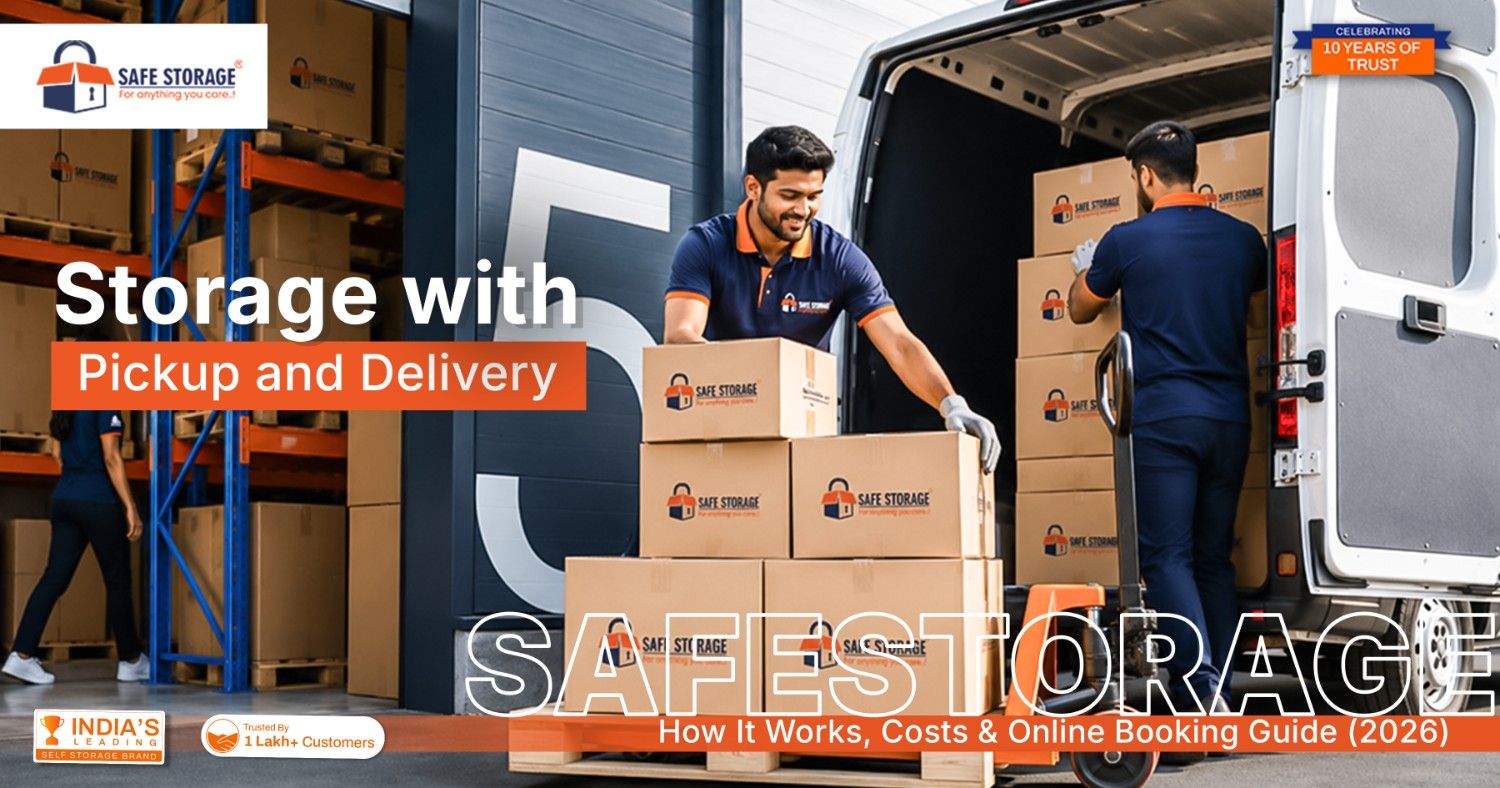
Storage with Pickup and Delivery: How It Works, Costs & Online Booking Guide (2026)

Booking storage online, with pickup handled at your door.

Key takeaways
  • SafeStorage picks up from your Bangalore home — no driving to a facility yourself.
  • Plans start from Rs 99 per month, with a one-month minimum.
  • Every item is barcoded and insured against fire, theft, water damage, and pests.
  • Part-retrieval lets you pull out a single box without ending the whole plan.
  • Rated 4.9 across 7,158 Google reviews.

What's actually included in a plan

It helps to know exactly what's covered before comparing this against a bare storage unit or a relative's spare room, since the details are what make the difference for most households.

A lot of people assume self storage means an empty unit and a padlock, full stop. SafeStorage's Bangalore plans include more of the process than that:

  • Doorstep pickup and drop-back, scheduled around your day
  • Free packing materials for anything fragile
  • A barcoded, searchable inventory of everything stored
  • Insurance covering the full storage period
  • Part-retrieval — take out one box without closing the plan

Why doorstep pickup matters more than it sounds

Most self storage providers expect you to pack, load, and drive to a facility, then repeat the trip in reverse whenever you want something back. In Bangalore traffic, that round trip alone can eat an afternoon on either side of the city. Doorstep pickup turns it into a scheduled slot at home — no queue, no parking hunt, no half-day written off.

It changes the calculation for what's even worth storing. A bare unit you have to drive to only makes sense for large, infrequent items — nobody wants to make a round trip across the city for one suitcase. Pickup removes that threshold entirely, so smaller, more frequent storage — a season's worth of decor, a spare mattress, a box of documents — becomes worth doing instead of just living with the clutter.

What it costs to start

DetailWhat to expect
Starting priceFrom Rs 99 per month
Minimum period1 month
What's coveredFire, theft, water damage, and pests

You pay for the space your items actually take up, not a fixed unit sized for your busiest month.

Who tends to use this

Households clearing a spare room before a new arrival, families storing festival and seasonal items between uses, and anyone mid-move who needs somewhere for boxes between two addresses all show up in the same pattern: stuff that's needed eventually, just not this month.

A few less obvious cases come up too — someone renovating one room at a time who needs furniture out of the way without moving it far, or a family holding onto a relative's belongings for a while without turning a spare room into permanent storage. In each case, the point isn't getting rid of things, it's freeing up the room they're currently sitting in.

Self Storage Prices in Bangalore, Hyderabad, Chennai & Mumbai: Complete Cost Guide (2026)

Bangalore pricing sits alongside SafeStorage's other city plans.

Tip: Photograph anything fragile before pickup, even though it's insured and barcoded — it makes any future claim or retrieval request faster to sort out.

Booking it without overthinking it

Because the minimum commitment is one month, there's little reason to hesitate over a trial run. Book a pickup for whatever's crowding one room, see how the barcoded system works when you want something back, and scale up from there if it's useful.

Most people over-plan this step, trying to decide in advance exactly how much space they'll need for the next year. It's simpler to start with whatever's causing the immediate problem — one crowded room, one overflowing cupboard — and add to the plan later if more comes up. The barcoded inventory means adding a second batch of items later doesn't create any confusion about what's already stored.

Worth noting before you book: a 4.9 rating across 7,158 Google reviews isn't just a number on a page — at that volume, it reflects a pattern across thousands of separate pickups, retrievals, and claims, not a handful of enthusiastic early users. For a service built around trusting a stranger with your belongings for months at a time, that consistency at scale is usually the detail worth checking before anything else.

Frequently asked

Do I have to sort everything before pickup?

No — items are catalogued and barcoded at intake, so sorting can happen as part of that process.

What if I only need one box back?

Part-retrieval covers exactly that — a single item can be pulled out without ending the rest of the plan.

Is there a long-term contract?

The minimum period is one month, so it works for short-term needs as well as ongoing storage.

What happens if something gets damaged in storage?

Every item is insured against fire, theft, water damage, and pests for the full storage period.

Full pricing, sizes, and the booking process are on SafeStorage's Bangalore page.

Friday, 25 September 2026

Where Does Your Furniture Go Between Two Bangalore Homes?

Every household move in Bangalore hits the same wall eventually: the new place isn't ready, the old one has to be vacated, and somewhere in between is a truckload of furniture with nowhere to go. That gap is exactly what household storage exists to close, and knowing how it actually works before you need it saves a lot of last-minute scrambling.

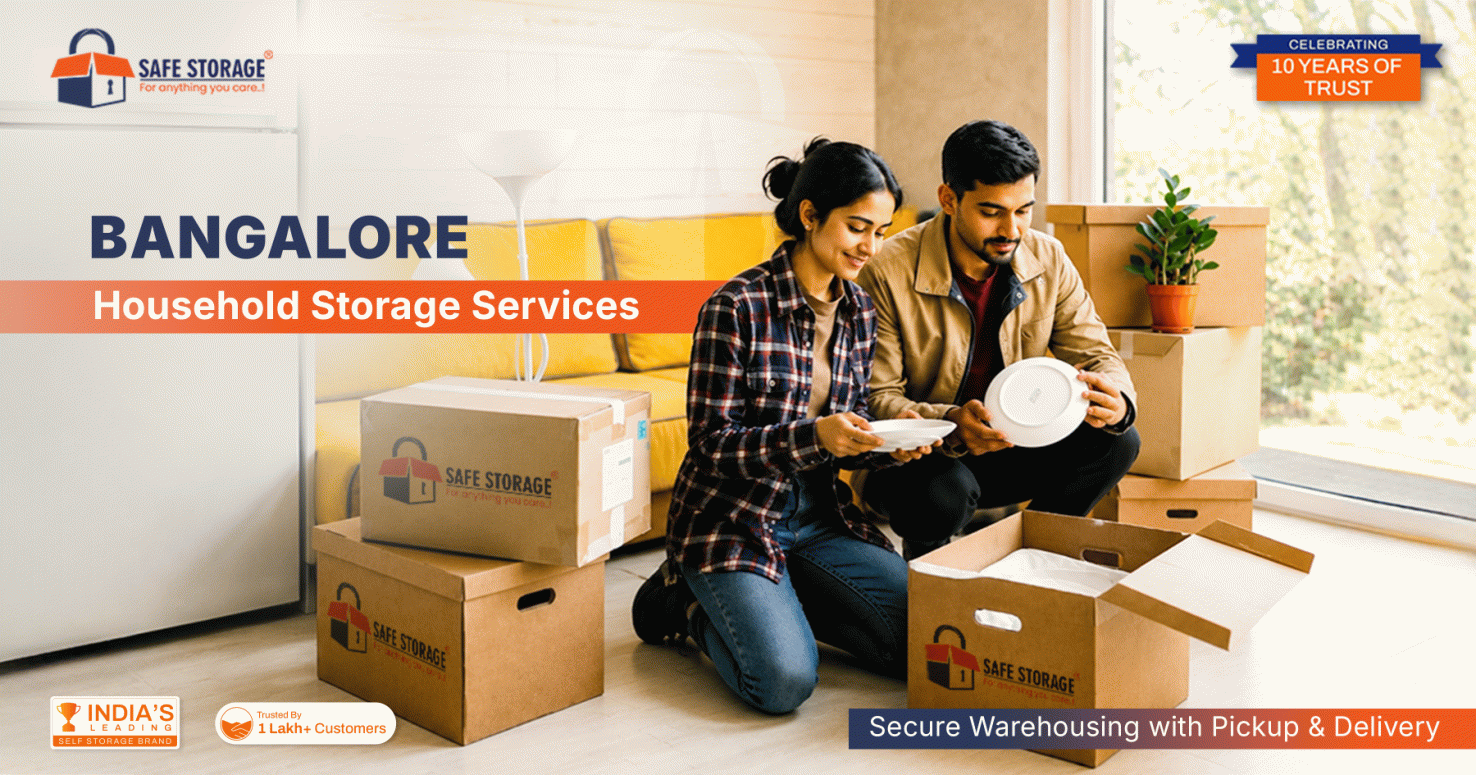
Bangalore Household Storage Services: Secure Warehousing with Pickup & Delivery

Doorstep pickup means your furniture never has to sit on a truck waiting for the new place to be ready.

Key takeaways
  • Household storage in Bangalore is built for the gap between moves, renovations, downsizing and travel — not as a permanent solution.
  • SafeStorage picks everything up from your door, photographs and barcodes each item, and stores it in a monitored warehouse.
  • Plans start from Rs 99 per month with a minimum period of one month, so short gaps don't require a long commitment.
  • Large furniture is disassembled where possible before loading, saving space and reducing handling risk.
  • A small, clear list of items — perishables, live plants, gas cylinders, flammable liquids — is simply not accepted.

The situations that actually call for this

Household storage tends to get used at very specific moments rather than as an everyday habit. The most common one is moving between rentals with a gap in between — the old lease ends before the new one starts, and your furniture needs somewhere to exist for a few weeks that isn't a hallway. Renovation is another: clearing a room down to bare walls is far easier, and far safer for your furniture, than working around it in a corner covered in a sheet.

Downsizing into a smaller flat, relocating for work with only some belongings coming along, and simply running out of space for things used a few times a year round out the common cases. None of these are permanent situations, which is exactly why storage priced and structured around a minimum of one month, rather than a long lease-style commitment, fits them so well.

What actually happens to your things

  • A team comes to your door in Bangalore, packs and wraps items, and moves them — you don't drive anything to a facility yourself.
  • Everything is photographed and barcoded before it goes into the warehouse, creating a specific record for each item.
  • That same barcoded inventory lets you request individual pieces back later without disturbing the rest of what's stored.
  • Large items like wardrobes and dining tables are disassembled where possible, which reduces both the space they take up and the risk of damage in transit.

What is and isn't accepted

Most furniture, mattresses, appliances, kitchenware, books, clothing, sports equipment, seasonal decor and boxed documents are covered without issue. What isn't: perishable food, live plants, gas cylinders, flammable liquids, and anything needing refrigeration. If you're unsure whether a specific item qualifies, it's worth raising it during the initial estimate call rather than discovering it on pickup day, so the team can plan around it in advance.

What it costs and how long you need it

DetailWhat to expect
Starting priceFrom Rs 99 per month
Minimum periodOne month
PickupFrom your door in Bangalore
Access to itemsIndividual pieces can be requested back via the barcoded inventory
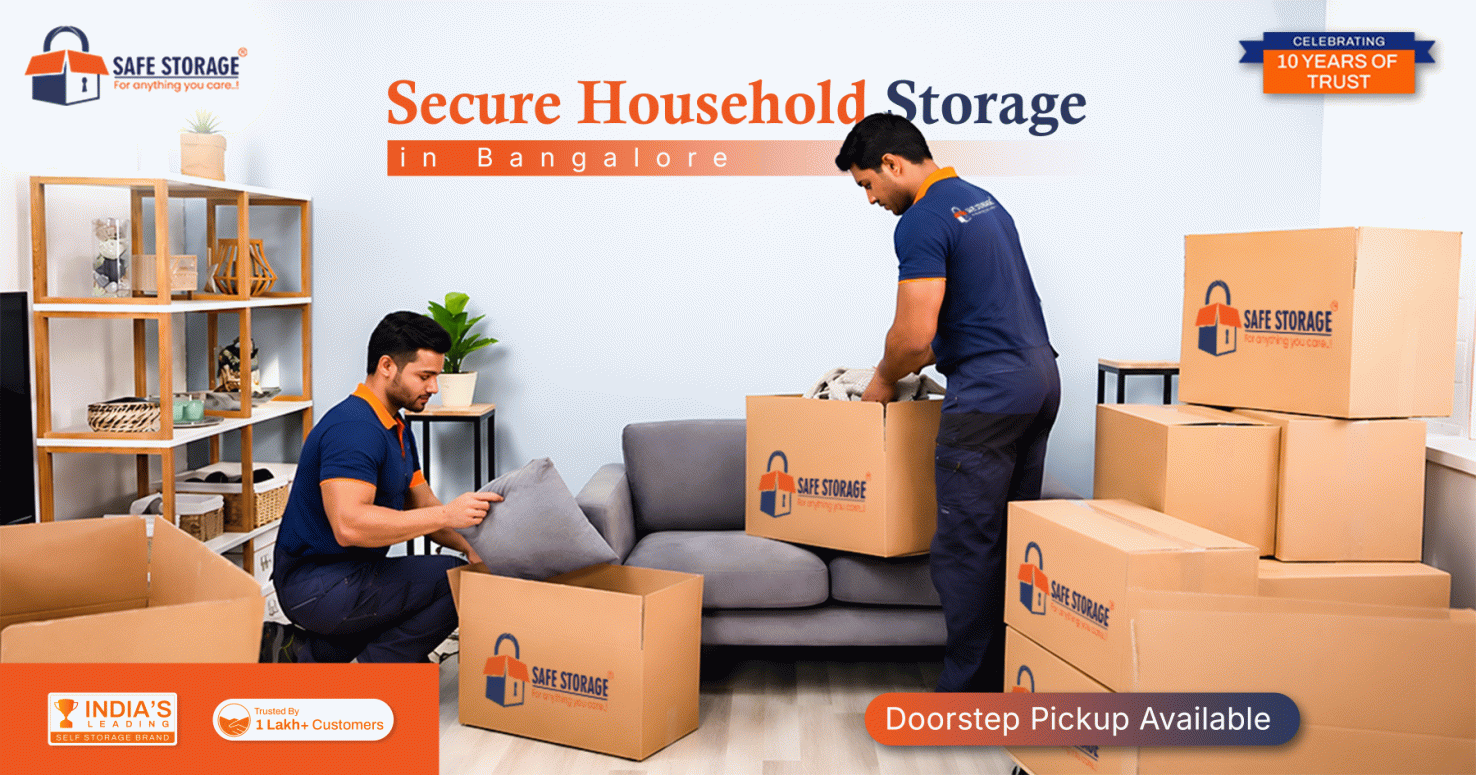
Secure Household Storage in Bangalore – Doorstep Pickup Available

Storing furniture properly during a renovation protects it far better than covering it in a corner of the flat.

Planning around a move without the stress

The households that get the most out of storage are usually the ones who plan for it a few weeks ahead rather than the week of the move. Booking pickup once your moving date is confirmed, sorting out what's going into storage versus what's coming with you immediately, and flagging anything unusual during the estimate call all make pickup day much smoother than trying to sort it out on the spot.

It also helps to walk through the flat room by room before pickup day and decide, honestly, what's going into storage versus what's coming with you straight away. Households that do this tend to end up with a shorter, clearer list for the team, which makes the actual pickup faster and leaves less room for anything to be missed or misplaced in the shuffle of a busy moving day.

Practical tip

Photograph valuable or fragile items yourself before pickup, in addition to the barcoded record — it's a small extra step that makes any conversation about condition later much simpler.

Do I need to be present for the pickup?

Someone needs to be available to hand items over so the team can photograph and barcode everything at the point of collection.

Can I get individual items back before the rest of my storage?

Yes — the barcoded inventory lets you request specific pieces back without disturbing everything else in storage.

What's the shortest period I can store for?

Plans start from a minimum of one month, with pricing from Rs 99 per month.

Will large furniture be taken apart before storage?

Where possible, yes — items like wardrobes and dining tables are disassembled, which reduces space used and handling risk.

If a move, renovation or downsizing is coming up in Bangalore, the full details of how doorstep pickup, barcoding and pricing work are laid out on the SafeStorage household storage page.

Tuesday, 22 September 2026

A Practical UAE Storage Guide for Relocating Indian Families

Families and businesses moving from India to the UAE ask us the same handful of questions on almost every call. This is the direct version of those answers, without the sales pitch, so you can plan the storage part of your move before the rest of the relocation catches up with you.

Why Dubai Rising Businesses Choose Self-Storage Over Warehouses

Doorstep pickup is the one part of the move you don't have to plan around a warehouse's hours.

  • Storage should be arranged before your shipment or move date, not after you're already overwhelmed
  • Doorstep pickup covers Dubai, Abu Dhabi, Sharjah and Ajman with the same process
  • Barcoded inventory means individual boxes or furniture pieces can be tracked and retrieved separately
  • A guarded warehouse removes the walk-in unit from your list of things to manage

Question one: when should storage be arranged?

As early as you know a move is happening. Families relocating from India often underestimate the gap between leaving one home and settling into a UAE property, and that gap is exactly when storage needs to already be in place, not something you're scrambling to find.

Question two: walk-in unit or doorstep pickup?

A walk-in unit means finding a facility, renting a van, and doing the loading and driving yourself. Doorstep pickup means a team comes to you, collects, barcodes and stores everything, and brings it back on request. For anyone managing a cross-border move on top of visas, schooling and jobs, doorstep pickup removes an entire task from the list.

Question three: what actually gets stored?

  • Household furniture and boxes during a gap between properties
  • Business inventory, stock or paperwork ahead of a UAE office opening
  • Seasonal or rarely used items that don't need to travel with the rest of the shipment
  • Anything from a downsized India home that's being kept for later

Question four: how is everything tracked?

Each box or piece of furniture is barcoded at collection. That barcode is what lets you request one item back without the whole lot being disturbed — useful whether you need a single file from a business archive or one box of kitchen items from a household move.

Question five: what if we're not fully settled yet?

That's the situation we see most often, and it's exactly what doorstep storage is built for. Plenty of the families we work with have a confirmed UAE address but haven't finished furnishing it, or are staying somewhere temporary while they finalise a longer-term home in Dubai, Abu Dhabi, Sharjah or Ajman. Storage doesn't need a finished home to start — it just needs somewhere for the pickup team to collect from.

The same applies to businesses waiting on an office fit-out to complete. Stock, files and furniture can be collected and stored the moment they're ready to move, well before there's a finished office to receive them, so nothing sits in a hallway or a half-set-up space in the meantime.

Question six: how do families juggling two countries handle this?

Quite a few of the people we speak with are NRIs keeping some presence in both India and the UAE, at least for a while. For them, doorstep storage in the UAE covers exactly the items that don't yet have a settled home on either side — stored, tracked, and released whenever that decision finally gets made.

Question seven: what should be decided before the first call?

Just three things really: a rough UAE address, a rough move date, and a sense of whether you're dealing with a household, a business, or both. Everything else, down to the exact box count, gets sorted out once the pickup team is actually on site and barcoding items as they're collected.

QuestionShort answer
When to book storage?As soon as a move date is set
Walk-in or doorstep?Doorstep saves a separate trip and a van
How is it tracked?Barcoded per box or item
Personal Self Storage Dubai Marina : Secure Storage Near You

Self storage near Dubai Marina works the same way as anywhere else in the UAE — pickup first.

Write a short list of what's going into storage before the pickup team arrives — it makes barcoding faster and gives you a record to check against later.

Does the same service work in every emirate?

Yes, the process is the same across Dubai, Abu Dhabi, Sharjah and Ajman.

Can storage be booked before we've even landed in the UAE?

Yes, pickup can be arranged around your confirmed address and timing once that's set, so it's ready the moment your shipment or move date arrives.

Is there a fixed duration for how long items can stay stored?

No, the whole point of doorstep storage is flexibility — items can stay for as short or as long as your situation needs, with no fixed end date.

What if we need only part of what's stored back?

Barcoded tracking means individual boxes or items can be requested without retrieving everything.

What if our family is splitting the move across a few months?

That's common, and it's handled the same way — pickups can happen across more than one visit as different parts of the household or business are ready to move.

Read the full details on SafeStorage or call +971 50 577 3388 to arrange pickup around your move date.

The Straight Answer to Your Storage Search, City by City

Most people only look up storage once, usually in a hurry, and end up choosing based on whichever result loads first. This is a direct, no-fluff answer for anyone doing that search right now: what you actually get, what it costs, and how the pickup itself works, city by city.

Doorstep Pickup, Secure Storage & Instant Booking – The SafeStorage Way to Store Smarter

Doorstep pickup and instant booking, the two things most searches are really after.

  • Pickup happens at your address — you never drive to a facility yourself
  • Every item is barcoded individually for accurate, partial retrieval
  • Storage is insured and kept in a guarded warehouse, not an open yard
  • Plans start from Rs 99 per month, minimum period 1 month
  • Covers Bangalore, Delhi, Mumbai, Chennai, Pune, Hyderabad, Noida and Gurgaon

What You're Actually Choosing Between

Search results for storage tend to mix two very different services: self-storage units, where you rent a locked room and load it yourself, and doorstep storage, where a team comes to you, packs and tags what you're sending, and delivers it back on request. Knowing which one you're looking at before you call matters — the pricing and effort involved are not comparable, and confusing the two is the most common reason people end up disappointed with whichever one they book first.

How the Pickup Actually Works

The process is the same regardless of city or reason for booking. A team arrives at your address, brings packing material for anything fragile, barcodes every box or piece of furniture individually, and loads it for transport to a guarded facility. There's no unit to find, no van to rent, and no carrying anything up or down stairs yourself.

This matters more than it sounds like on paper. Most people underestimate how much time a self-drive storage trip actually takes once you factor in finding parking near the unit, loading in a hurry, and doing it all again in reverse. A doorstep pickup removes every one of those steps from your day.

What It Costs and What's Included

Pricing starts from Rs 99 per month, with a minimum commitment of just 1 month — short enough to cover a renovation gap or a move, long enough to be worthwhile for ongoing overflow. Packing materials for fragile items and the barcoded inventory system are part of the standard process, not add-ons you need to negotiate separately.

The phone number for questions about pricing or a specific booking is 080888 48484, which is worth having ready if you'd rather talk through your item list than fill out a form.

Getting Items Back

Because every item is logged with its own barcode at pickup, retrieval requests can be specific — you don't need the entire consignment returned just to get one box of winter clothing. This matters most for anyone storing a mix of household and business items in a single booking.

Why Location Doesn't Change the Process

A common question is whether service quality varies between a larger metro like Mumbai or Delhi and a smaller catchment like Noida or Gurgaon. It doesn't — the same pickup team structure, barcoding system and guarded-warehouse standard apply across all 8 cities, so the process you read about here is the process you'll actually get, wherever you're booking from.

What you needSelf-storage unitDoorstep service
Getting items thereYou drive and load it yourselfA team collects from your address
Finding a specific item laterYou search the unit yourselfRequested by barcode, delivered to you
Insurance and securityVaries by providerInsured, guarded warehouse
Affordable Self Storage in Bangalore – Doorstep Pickup Today

A pickup in progress in Bangalore, one of the eight cities covered.

Before booking, have a rough item count ready — furniture pieces plus approximate box count. It speeds up the pickup slot booking and gives you a more accurate cost estimate upfront.

Who Actually Books This

  • Households moving between flats with a gap in between
  • Anyone renovating a room currently full of furniture
  • Families storing seasonal items like festive décor or winter clothing
  • Small businesses storing stock, files, or spare office furniture
  • Anyone relocating temporarily for work and needing somewhere secure for belongings in the meantime
  • Landlords or tenants clearing a property between tenancies

Do I need to be home during the entire pickup?

You need to be present when the team arrives to hand over items and confirm the inventory list, but the process itself is quick once everything is ready.

Is the minimum period really just one month?

Yes — the minimum period is 1 month, which suits short gaps between moves as well as longer ongoing storage.

Which cities does this actually cover?

Bangalore, Delhi, Mumbai, Chennai, Pune, Hyderabad, Noida and Gurgaon, all run through the same pickup and barcoding process.

Can I switch between household and business categories later?

Yes — the booking isn't locked to one category, so a household plan can accommodate business items later if your needs change, without opening a separate account.

If your search brought you here mid-move or mid-renovation, the full breakdown is on the SafeStorage page, or you can call 080888 48484 directly to book a pickup slot.

How to Estimate the Storage Space You Need Before You Book

One of the most common mistakes people make with storage is guessing the size. Too small and items get crammed; too large and you pay for air. A few minutes of estimating before you book avoids both.

Start with a room-by-room list

Write down every large item you plan to store: beds, wardrobes, sofas, tables, appliances. Then count cartons, grouped by room. Be honest; cartons multiply during packing.

Think in household sizes

Storage is often described in terms of a typical home: the contents of a studio, a one-bedroom flat, a two-bedroom flat and so on. Your list tells you which band you are in.

Dismantle what you can

A bed frame taken apart, a table with its legs removed and a wardrobe emptied and flat-packed where possible take far less space than the same items whole.

Leave room for access

If you will want items back one at a time, access matters. Good providers stack so that individual cartons can be retrieved.

Checklist

  • List large items and cartons.
  • Decide what can be dismantled.
  • Note anything fragile or valuable.
  • Decide how often you will need things back.
  • Share the list with the provider for a firm estimate.

Common estimating mistakes

People usually forget three things: the cartons that appear on packing day, bulky items stored in lofts and balconies, and appliances such as washing machines and spare fridges. Walk every room, including the balcony and store room, before you finalise the list. It is far easier to adjust an estimate before pickup than on the day the truck arrives.

A good estimate also protects your budget, because you pay for the space your goods need rather than a round number chosen on the day.

The SafeStorage team explains how to size your storage, what is included and how pickup and return work in this guide: a guide to sizing your storage. Bringing your list to that guide turns a guess into a clear estimate.

Before You Store Your Household Goods: Seven Questions Worth Asking

Handing over the contents of your home to a storage company is a bigger decision than it first appears. Most people make it quickly, in the middle of a move or a job transfer, and only think about the details later. A few questions asked up front save a lot of worry afterwards.

1. Will they list every item?

An inventory is the single most useful thing a storage provider can give you. It means you know exactly what is being held, and you can ask for one carton back instead of the whole consignment.

2. How is the warehouse protected?

Ask about pest control, fire safety, security cover and how moisture is managed during the monsoon. A clean, monitored facility is very different from an empty godown with a lock on the door.

3. Who does the packing?

Good packing prevents most damage. Check whether the team brings materials, how fragile items and furniture are wrapped, and whether you can pack some things yourself.

4. Is it drive-up or doorstep?

In India the common model is doorstep: a team collects, stores and returns your goods, and you rarely visit the warehouse. Make sure the service you choose matches how you want to work.

5. How quickly can you get things back?

Find out how much notice you need to give and whether partial returns are possible.

6. What happens if something is damaged?

Ask about protection plans and how claims are handled before you sign, not after.

7. How long must you commit?

Short minimum periods matter when your plans are uncertain.

The SafeStorage team has written a detailed explainer covering how the service works in India, how much space typical homes need and how to prepare your belongings: a practical guide to storing your belongings in India. Reading it before you book will help you ask the right questions and compare providers on the things that actually protect your furniture, documents and keepsakes.